 Food Editor
Editor’s Note: Editor’s Note: This article on the pavlova has been given to us to reprint in its entirety by Glen Ralph of the Wilmar Library, South Australia. Glen published this originally in his “Notes and Curieux,” an occasional newsletter with material which has come from researches undertaken in order to answer questions put by library users. This article traces the history of the pavlova. Perhaps what Glen has to say will put the battle of the pavlova to rest, but maybe not. In any case, whip up a pav and eat it like royalty. It is the most elegant of creations.
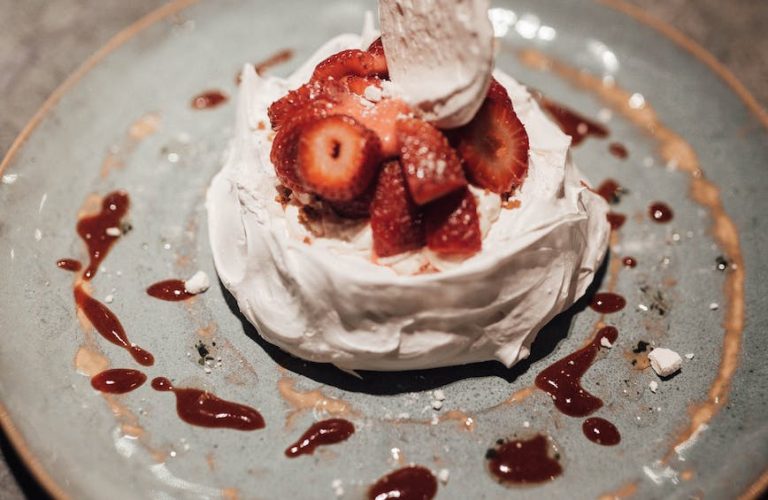
THERE’S long been an argument raging about the pavlova (with a small ‘p’) and I’ve been asked to settle it once and for all. Well, I’m not sure I’ve done that. What follows is my contribution, and I leave it to others to make up their own minds.Who invented the pavlova, that dessert which you often see covered with strawberries?
Forrest’s Dictionary of Eponymists (Kettering, Northamptonshire, J. L. Carr, 1978) is quite non-committal about it: “_Russian ballerina world revered for her solo dance, the Dying Swan. To honour her, Australia and New Zealand popularized a pavlova, a meringue filled with tropical fruit and served with cream, extras that belie Pavlova’s indivisible genius.” Collins English Dictionary describes the pavlova as: “a meringue cake topped with whipped cream and fruit, popular in Australia. Often shortened (Australian, informal) to pav.”
Let’s start with the meringue. It is a patisserie made from egg whites and sugar, and long preceded the pav, as the New Larousse Gastronomique by Prosper Montagne (Twickenham, Middlesex, Hamlyn, 1977, p.587) tells us: “Historians of cookery say that this little patisserie was invented in 1720 by a Swiss pastry-cook called Gasparini, who practised his art in Mehrinyghen, a small town in the State of Saxe-Coburg-Gotha. The first meringues made in France were served in Nancy to King Stanislas who, it is said, prized them highly. It was he, no doubt, who gave the recipe for this sweetmeat to Marie Leczinska. Queen Marie-Antoinette had a great liking for meringues. Court lore has it that she made them with her own hands at the Trianon, where she also made vacherins, for which a similar mixture is used. Up to the beginning of the nineteenth century, meringues were shaped in a spoon, as the pastry forcing-bag had not been invented.” The Larousse gives recipes for both the meringue and the vacherin:
Meringue
Ingredients. 12 egg whites, 500 g. (18 oz., 2_ cups) sugar, 1_ teaspoons table salt, flavouring to taste.
Method. Whisk the whites to a stiff foam. When they have risen well, add the salt and sugar. Fill a forcing-bag with this mixture, and pipe the meringues in the desired shape and size onto buttered and floured baking sheets. Sprinkle with sugar. Bake in a very slow oven.
After taking the meringues out, press the base of each one with the thumb to make a little hollow. Keep in a dry place.
The vacherin, according to Larousse (op. cit, p.951) is: “Sweet (dessert) made with meringue ‘crowns’ mounted one on top of the other on a sweet pastry base, decorated with meringue piped through a forcing bag and dried out in a very low oven; or with circles of almond paste similarly mounted on top of each other. These are filled either with Chantilly cream, ice cream flavoured with vanilla, or with some other flavouring, or with a bombe mixture.” The recipe using the meringue is as follows:
Vacherin with crown of meringue
(Vacherin avec couronne de meringue)
Method. With a forcing bag make circles of plain meringue on buttered and floured baking sheets, the diameter of the rings varying according to the size of the sweet to be prepared. Sprinkle with fine sugar and cook in the oven at a low heat until the meringue is well dried.
Put on a baking sheet, one on top of the other. Coat them with meringue. Using a pipe, decorate this ‘box’ with more meringue, sprinkle it with sugar and dry it again in the oven. Fill the box with sugar cooked to the crack stage, added to a base of chou pastry. When the vacherin is quite cold, fill with stiffly beaten, vanilla-flavoured cream, rounded into a dome.
The meringue spread to other places, with slight variations here and there, but remained basically whipped egg-whites and sugar. Two further recipes will serve to show how ideas of presentation differed from the above.
The first recipe comes from Mrs. Isabella Beeton, well-known for her Book of Household Management. Since she appears to have been largely ignored by compilers of reference books, it might not be out of place to first provide a short profile before giving the recipe. Isabella Mary Beeton was the eldest of a family of 21 brothers, sisters, half-brothers, half sisters, step-brothers and step-sisters and catering on that scale must have been the basis for what was to become the biggest-selling cookery book of all time. She was born Isabella Mayson in London in 1836 and, with her family, was brought up in the Grandstand at Epsom, where her step-father, Henry Dorling, was clerk to the racecourse.. She later went to Germany where she was educated at Heidelberg. Soon after her return to England, and at the age of 20, she married the publisher, Sam Beeton.
A year later, in 1857, Isabella began her colossal task of compiling Beeton’s Book of Household Management. With the painstaking care she paid to every detail it took her four years to complete. It first appeared in 1859 in monthly parts as a supplement to her husband’s Englishwoman’s Domestic Magazine from that year until 1861, and was very popular. Such was its acclaim that in 1861 Sam Beeton published the complete work, bound into one volume of 1,112 pages, and sold it at a price of 7s. 6d. Sadly, in 1865, and aged only 28, Isabella died of puerperal fever after the birth of her fourth child. Sam Beeton fell heavily into debt and was forced to sell his business to another publishing company, the firm Ward and Lock (Later Ward, Lock and Co.). He died in 1877 at the age of 46, but his remarkable joint enterprise with Isabella succeeded in producing a unique manual which has remained in print in numerous versions of the original, and is undoubtedly the greatest cookery book in English, only Eliza Acton’s Modern Cookery (1845) being a serious rival. Isabella’s book in the first edition is now extremely rare. The reprints published by Ward, Lock and Co. bear little or no resemblance to the original publication, and actually became worse with each subsequent issue. The recipe below is taken from a facsimile edition published by Chancellor Press, London (1982).
MERINGUES
INGREDIENTS.- 1/2 lb. of pounded sugar, the whites of 4 eggs.
Mode.-Whisk the whites of the eggs to a stiff froth, and, with a wooden spoon, stir in quickly the pounded sugar; and have some boards thick enough to put in the oven to prevent the bottom of the meringues from acquiring too much colour. Cut some strips of paper about 2 inches wide; place this paper on the board, and drop a tablespoonful at a time of the mixture on the paper, taking care to let all the meringues be the same size. In dropping it from the spoon, give the mixture the form of an egg, and keep the meringues about 2 inches apart from each other on the paper. Strew over them some sifted sugar, and bake in a moderate oven for 1/2 hour. As soon as they begin to colour, remove them from the oven; take each slip of paper by the two ends, and turn it gently on the table, and, with a small spoon, take out the soft part of each meringue. Spread some clean paper on the board, turn the meringues upside down, and put them into the oven to harden and brown on the other side. When required for table, fill them with whipped cream, flavoured with liqueur or vanilla, and sweetened with pounded sugar. Join two of the meringues together, and pile them high in the dish.
To vary their appearance, finely-chopped almonds or currants may be strewn over them before the sugar is sprinkled over; and they may be garnished with any bright-coloured preserve. Great expedition is necessary in making this sweet dish; as, if the meringues are not put into the oven as soon as the sugar and eggs are mixed, the former melts, and the mixture would run on the paper, instead of keeping its egg-shape. The sweeter the meringues are made, the crisper will they be; but, if there is not sufficient sugar mixed with them, they will most likely be tough. They are sometimes coloured with cochineal; and, if kept well covered in a dry place, will remain good for a month or six weeks.
Time.-Altogether, about 1/2 hour.
Average cost, with the cream and flavouring, 1s.
Sufficient to make 2 dozen meringues. Seasonable at any time.
In an unkind footnote in his book Understanding Book-Collecting (Woodbridge, Suffolk, Antique Collectors’ Club, 1982, p.104) Grant Uden says: “Though her book is reckoned the classic work on how to prepare good food and run an efficient household, the picture of Isabella Mary Beeton (1836-65) as a vastly experienced hostess and housewife propounding her own recipes is entirely false. She was, in fact, only twenty-nine when she died and it is reckoned that she personally contributed only one recipe.” (italics mine) That may or may not be, but even if it was true, was it fair? Even the greatest chefs in the world do not “propound” recipes by the score and publish them in books.
The Dictionary of Daily Wants, a book published in London by Houlston and Sons, probably in the 1880s, does not list Mrs. Beeton as one of its “authorities.” It offers a recipe, our second example:
MERINGUES
A species of confection which forms a part of a better class of repast, and which is made as follows:–
Whisk to the firmest possible froth the whites of six new-laid eggs, taking every precaution to prevent the smallest particle of yolk from falling amongst them. Lay some squares or long strips of writing-paper closely upon a board, or upon very clean trenchers. When all is ready, mix with the eggs three-quarters of a pound of the finest sugar, well dried and sifted; stir them together for half a minute, then with a tablespoon lay the mixture quickly on the paper in the form of a half-egg; sift sugar over them without delay, blow off all that does not adhere, and set the meringues in a gentle oven. The process must be expeditious, or the sugar melting will cause the cakes to spread, instead of retaining the shape of the spoon as they ought. When they are coloured to a light brown, and are firm to the touch, draw them out, turn the papers gently over, separating the meringues from them, and with a teaspoon scoop out sufficient of the insides to form a space for some whipped cream or preserves, and put them again into the oven upon clean sheets of paper, with the moist sides uppermost, to dry; when they are crisp enough they are done; let them become cold, fill and join them together with a little white of egg, so as to give them the appearance shown in the engraving. Spikes of almonds can be stuck over them as there represented.
Eggs, 6 whites; sugar 3/4 lb.; almonds, sufficient.
The Pavlova
From the meringue it was another step, a giant ballet step for mankind as it were, to “propound” or create the pavlova.
There is no doubt that the famous dessert was named after Anna Pavlova, as has already been mentioned above. But there is much less certainty about who created it. Some allege an Australian origin, and others that it originated in New Zealand. Who has the right of it?
To answer the question I undertook a little research, the results of which I present here, but without wishing in any way to claim that the whole story has been uncovered. There may yet be more, and, as will appear, I was not able to verify everything.
I found the most useful reference to be The Australian National Dictionary; a dictionary of Australianisms on historical principles, edited by W. S. Ramson (Melbourne, Oxford University Press, 1988), which I reproduce here in part, omitting some quotations which seem fairly irrelevant:
Pavlova. [from the name of Anna Pavlova (1885-1931), Russian ballerina: see quote 1971]
1. A dessert; a large, soft-centred meringue topped with whipped cream and fruit.
[N.Z. 1927 Davis Dainty Dishes (Davis Gelatine N.Z., Ltd) (ed. 6) 11 Pavlova_
Dissolve all but a teaspoonful of Gelatine in the hot water, and all the sugar [etc.]
1929 K. McKay Practical Home Cookery 155/1 Pavlova cakes_Cook like
Meringues_They are delightful and simple to make besides being a novelty.]
1940 WESTACOTT & LOWENSTEIN 275 Choice Recipes 40 Pavlova Cake. Four eggs, 8 ozs. Castor sugar, 1 dessertspoon vinegar, 1 dessertspoon cornflour; 1 pinch cream of tartar. Beat whites stiff, fold in sugar, beat till dissolved, add other ingredients, lastly vinegar. Line a 9-inch tin with grease-proof paper slightly moistened; allow sides to stand up 4 inches as it rises very much, bake 1 1/2 hours in slow oven. Turn out and leave upside down to cool. Turn over and put whipped cream and passion fruit on top.
The Australian National Dictionary gives other citations, some of which, among other things, will be referred to below. There is, however, one reference, cited by the editor I suspect out of a sense of fun rather than from the obligations of scholarship, and I cannot forbear to reproduce it here, perhaps for the same reasons:
1986 P. GOLDSWORTHY Zooing 114 Pavlova n. (comm. abbrev. Pav.), a famous Australian dessert, named due to its mouth-watering properties in honour of the distinguished Russian physiologist Ivan Pavlov (1849-1936).
Well, we all make mistakes sometimes.
The change from the egg-shaped meringues of Mrs. Beeton and the Daily Wants to the pavlova we know today seems to have been made in the late 1920s. The first recipe I was able to trace was that mentioned in the Australian National Dictionary, the one which appeared in the Davis Gelatine booklet, Davis Dainty Dishes, in the edition published in 1927. In order to confirm this I searched for a copy. The only copy recorded in Library collections seems to be that held by the New Zealand National Library. I sent an email to them, and hoped for a reply. Unfortunately my request was ignored, and I am therefore unable to confirm whether or not the recipe published therein was called a pavlova. The renowned ballerina had just completed a triumphal tour of Australia and New Zealand. It was reported in the press_”Expectations reached the highest point and every eye was focused on the stage from the packed balconies and stalls of His Majesty’s Theatre in Melbourne tonight, when the curtains of an alcove in a Moscow toy shop parted and the world’s greatest prima ballerina, Anna Pavlova, was revealed to the excited and applauding audience in the ballet Coppelia.” (13 March 1926)
The New Zealand claim is dealt with by Michael Symons in One Continuous Picnic: a history of eating in Australia (Adelaide, Duck Press, 1982), but with no mention of the Davis Gelatine booklet:
“In A taste of New Zealand in Food and Pictures, N. A. Munro stated in 1977: ‘It is often claimed, and perhaps justly, that the ‘Pav’ of affectionate parlance is New Zealand’s first and only contribution to international cuisine – that is, excluding foodstuffs native only to this country.’ Munro credited the idea to a nameless “benefactress” and fancied a date of ‘probably 1926, when the great ballerina toured this country, or shortly afterwards.’ To help check this for me, librarians of the National Library of New Zealand kindly consulted their collection of cookery books. In fact, they found a recipe for “Pavlova Cakes” in Mrs. McKay’s Practical Home Cookery, Chats and Recipes, published in 1929. The ingredients were roughly those of a pavlova, but it was not the pavlova as we know it, because the mixture was baked into three dozen little meringues. But there is more to the New Zealand claim than this. Even earlier, in Terrace Tested Recipes, collected by the ladies of Terrace Congregational Church, the second edition published in Wellington in 1927, there was a recipe submitted by a Mrs. McRae for Meringue Cake. This was three whipped egg-whites, eight ounces of sugar and a dessertspoon of cornflour (the pavlova ingredients less vinegar), put into two well-greased sandwich tins ‘in a fairly hot oven on a low shelf and leave until the fire is almost out.’ The two halves were filled with whipped cream and cherries or strawberries, or served as two cakes. From similar recipes published in 1933 and 1934, I think it fair to say that the Meringue Cake was common in New Zealand in the early 1930s. Its form varied, but it was to all intents and purposes what we know as a “Pavlova,” sometimes even complete with passionfruit on top.” (page 150)
Another contribution to the debate comes from The Bulletin columnist Ross Campbell. In a lively article he related his experience with the pavlova at Harrods in London. The article is worth reproducing in full, although parts of it are not entirely relevant here. Perhaps it should be noted that there is no support for Campbell’s statement that passionfruit is a “fruit unique to Australia.” (See Passion Fruit, by J. Farrell, E. E. Prescott, F.L.S., and F. H. Read, an article in a book edited by W. A Shum, entitled Australian Gardening Today. Adelaide, The Advertiser, n.d., pp.277-279). Campbell wrote:
THE BATTLE OF THE PAVLOVA
HARRODS is still the most classy department store, even though it advertises on buses now (“open all Saturday with a cast of thousands”). It is the place to go if you are looking for a _200 chess set with a board three feet square, or a Christmas-wrapped vintage Rolls and Bentley labelled His and Hers. So I felt a touch of satisfaction when I saw in their cake department a sign saying “Pavlova Cake-20p. a slice” (that is A.43 cents). The Pavlova, a distinctive Australian contribution to cuisine, had been officially recognized as posh.
“But I was shocked to read the rest of the notice. It said: “Pavlova Cake was created in New Zealand as a tribute to the dancer Anna Pavlova.” Furthermore, the specimen on display was not authentic. Instead of the traditional passionfruit on top of the cream it had strawberries. And the base did not seem to be the proper meringue; it was some brown crusty stuff.
“Indignant, I strode out of the gilded food Halls of Harrods and rang the New Zealand Government Offices. I told them what I had seen. “Does New Zealand really claim to have invented the pavlova?” I asked.
“The reply was courteous but non-committal. An information lady said that Pavlova cake was certainly made and eaten in New Zealand, and some people thought it had been created there. But she did not know for sure whether this was true.
“I consulted the memoirs of Pavlova in the British Museum Library. She had visited Australia and New Zealand in 1926, and Australia again in 1929. But she made no mention of the invention of the Pavlova. She does not seem to have appreciated the importance it would have in perpetuating her fame.
“I then wrote a letter, in a restrained but forceful style, to the manager of Harrods’ Food Halls. I said that the Pavlova – not “Pavlova cake” – was believed in Australia to be an indigenous creation. The fact that it was normally made with passionfruit, a fruit unique to Australia, was strong evidence for the truth of this belief. “The so-called Pavlova cake in Harrods,” I concluded, “made without meringue or passionfruit, gives a wrong impression of the true Australian Pavlova, tasty though it may be.”
The next day I received a telephone call from Mr. R. Jackson, Bakery and Confectionery Buyer for Harrods. He said my complaint about their Pavlova cake had been referred to him. I noticed that he pronounced it PAVlova. I refrained from pointing out that the usual pronunciation was PavLOVa, and anyone calling it a PAVlova ran a risk of being suspected of decadent tendencies.
“Mr. Jackson’s tone was conciliatory. He said: “We are neutral in this matter. We don’t really care whether Pavlova cake was invented in New Zealand or Australia. What matters to us is that it is a good selling line at Harrods. But we don’t want to stir up controversy and ill-feeling. So in view of what you have told us we have removed the placard.”
“I told him I appreciated this prompt action. But, I asked, could not the store now make a proper Australian PavLOVa with meringue and passionfruit?
“Actualy, our PAVlova cake does have a meringue base,” said Mr. Jackson. “But we found the meringue tended to fall apart without support, so we enclose it with a kind of outer crust.”
“I see. And what is the crust made of?” I asked.
“I would prefer not to reveal that,” he replied. “With regard to the passionfruit, we started out putting passionfruit on our Pavlova cakes, but they didn’t sell. People didn’t like the look of all the seeds and liquid stuff on top. We switched to strawberries and the sales trebled at once.”
“The removal of the offending placard was a gratifying achievement. To that extent I had successfully challenged the might of Harrods. But Mr. Jackson did not say they would put up another placard giving Australia credit for the Pavlova. Also I was wounded by the slur on passionfruit.
“Behind the whole affair I thought I could sense a whiff of a not uncommon English bias. It is felt by many here that New Zealanders are a decent, solid, rugger-playing lot, but Australians – well, look at all their queer mining companies. I am not confident that our image would help to sell Pavlovas at Harrods today.” The Bulletin 11 Dec 1971: 13-14.
This leaves the Davis Gelatine recipe as possibly the first real ‘pav,’ if it was a recipe for the pavlova as we now know it. It is unfortunate that it has not been possible to verify this.
There is yet more to our story. A further development of the pavlova recipe is credited to West Australian chef Herbert Sachse, and fortunately, unlike the question of the first pavlova, this is verifiable. Brian Hoad, another Bulletin writer, in an article about a film then being made, the $30 million Anglo-Soviet co-production, Pavlova, which starred Galina Baliaeva, wrote:
“_In 1935 at the Esplanade Hotel in Perth (now demolished) Herbert Sachse whipped up a meringue and cream confection in her [Pavlova’s] memory. Housewives across the nation have been commemorating her in their kitchens ever since.” (Article: Film glosses over Pavlova’s turning points. The Bulletin 16 Apr 1985 p.72.)
This comment in the article prompted an irate Kiwi to write to the Editor a letter which gives another story on the origin of the pavlova. L. G. Simmiss, of Como, W.A., wrote:
“Referring to Brian Hoad’s article on Dance and Pavlova (B, April 16); as a Kiwi in residence in Australia for the past ten years, I have managed most times to keep my mouth partly shut on the merits of Australian lamb v. NZ, etc., but in reading that the now-famous Kiwi dessert, the “Pavlova,” was “whipped up” by one Herbert Sachse in the Esplanade Hotel in Perth in 1935 I feel it is time to open wide and dispel this myth. New Zealand’s No. 1 indigenous dessert, the “Pavlova,” was created there after a visit by Pavlova in 1926 and the first published recipe was in the Otago Daily Times on June 26, 1934 – one year earlier than Herbert’s efforts. How about using your excellent magazine to publish the fact?”
The reference to the new Zealand newspaper is a problem, since no copies are held locally, and it is likely that a request addressed to the New Zealand National Library might well be as fruitless as the Davis inquiry. But it opens up yet another possibility for the origin of the pavlova as we now have it. Brian Hoad’s story is supported by “The Macquarie Dictionary of Australian Colloquialisms,” published under the general title Aussie Talk (McMahon’s Point, N.S.W., Macquarie Library, 1984):
“pav n. a pavlova. [the pavlova was invented in 1935 by Herbert Sachse, 1898-1974, Australian chef, and named by Harry Nairn of the Esplanade Hotel, Perth, after Anna Pavlova, 1885-1931, Russian ballerina]” (page 232)
Herbert Sachse (the name is variously pronounced as SACKS and SACK-SEE) was a farmer in W. A. A brief sketch of his life can be found in The Family Sachse. From Tschausdorf, Prussia to South Australia, 1855-1987, compiled by A. F. Barnes for the Sachse Family Reunion Committee, 1987. According to Herbert’s younger daughter, Margaret (Mrs. M. M. Weller), her father “invented” the pavlova, as she recalled for Mr. Barnes:
“We were on a property belonging to my mother’s father, in what was then known as “The Midlands,” at the towns of Coomberdale and Caroow. The area suffered a four-year drought that finally made the family leave the property, there being no assistance from the Government in those days. My mother was an exceptionally good cook and taught my father to cook, who eventually became Head Chef at the Esplanade Hotel, in Perth. While at the Esplanade Hotel he invented the sweet he named “Pavlova.” There is an article of him in “Australians.”” (Barnes, op. cit. p.102)
Bernard Herbert Francis Sachse was born on 12th May 1898 at Boulder, Western Australia, and had followed various occupations in his life, and died aged 75 on 1st April, 1974, at Kalgoorlie, where he was on holiday. Mr. Barnes cites a newspaper clipping (no reference given), which he said had been sent to him. The clipping read:
“The Esplanade, as every sweet tooth knows, was the culinary temple wherein the world famous pavlova was created by the late Bert Sachse for ballerina Anna Pavlova at the urging of the late and then Elsie Paxton. Bert told me all about it one day in his kitchen after he had switched over to the Palace Hotel. (Anna Pavlova visited Perth about 1925 or 1926.).” (Barnes, op. cit., p.103)
The combined evidence of Mrs. Weller, an unnamed reporter, and Brian Hoad in The Bulletin, as quoted above, make a case for the Sachse claim. The new dish was somewhat different from the “pavlova cakes” of earlier years. The Sachse pav. was not in the form of “cakes,” but was, and is, rather, a dish served up on a flat plate, and covered with whipped cream and fruit – passionfruit, strawberries, or other, according to taste. Arthur Barnes has further comment which is of interest:
“In August 1985 a daily newspaper published an article titled “Kiwi chefs get into a stew over pavlova’s ocker origins.” Therein we read that New Zealand chefs rebuff Astralian claims that the pavlova was invented in Perth. That “Kiwis are gathering evidence that the pavlova was not invented by Herbert Sachse,” but was the creation “of a country housewife near Oamaru in the South Island about a decade earlier.” However, it is not supported by indisputable evidence. Will the Sachse Families support the late Bert Sachse claim to fame? I hope so, hence the reason for mentioning the dispute, and the disparaging and insidious statement from New Zealand, “Ocker attempt to hog the pav.”” (Barnes, op. cit., p.103)
It seems not unreasonable to assume, considering all the evidence given above, that the pavlova of New Zealand, be it the Davis Gelatine or the Mrs. McRae variety, was a pavlova cake, while the Sachse delicacy is the dinkum Aussie dish we all prefer. In this way everybody gets a slice of the cake, or a fair serve, and we can finish our meal in peace.
History of the Pavlova